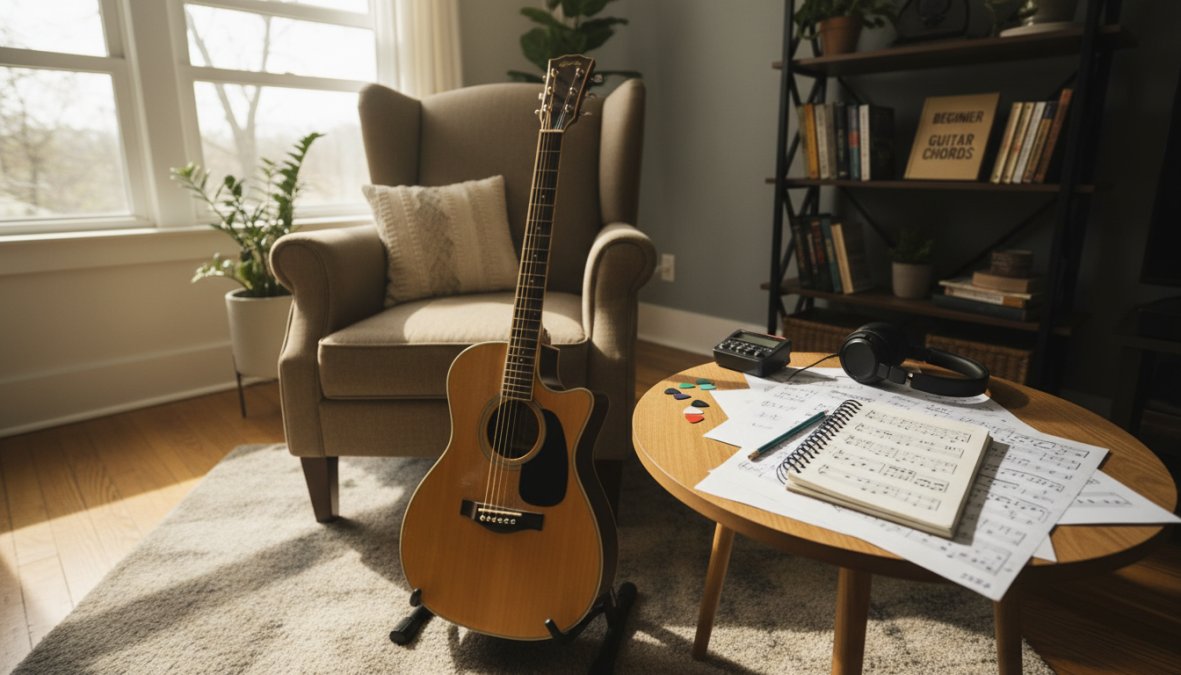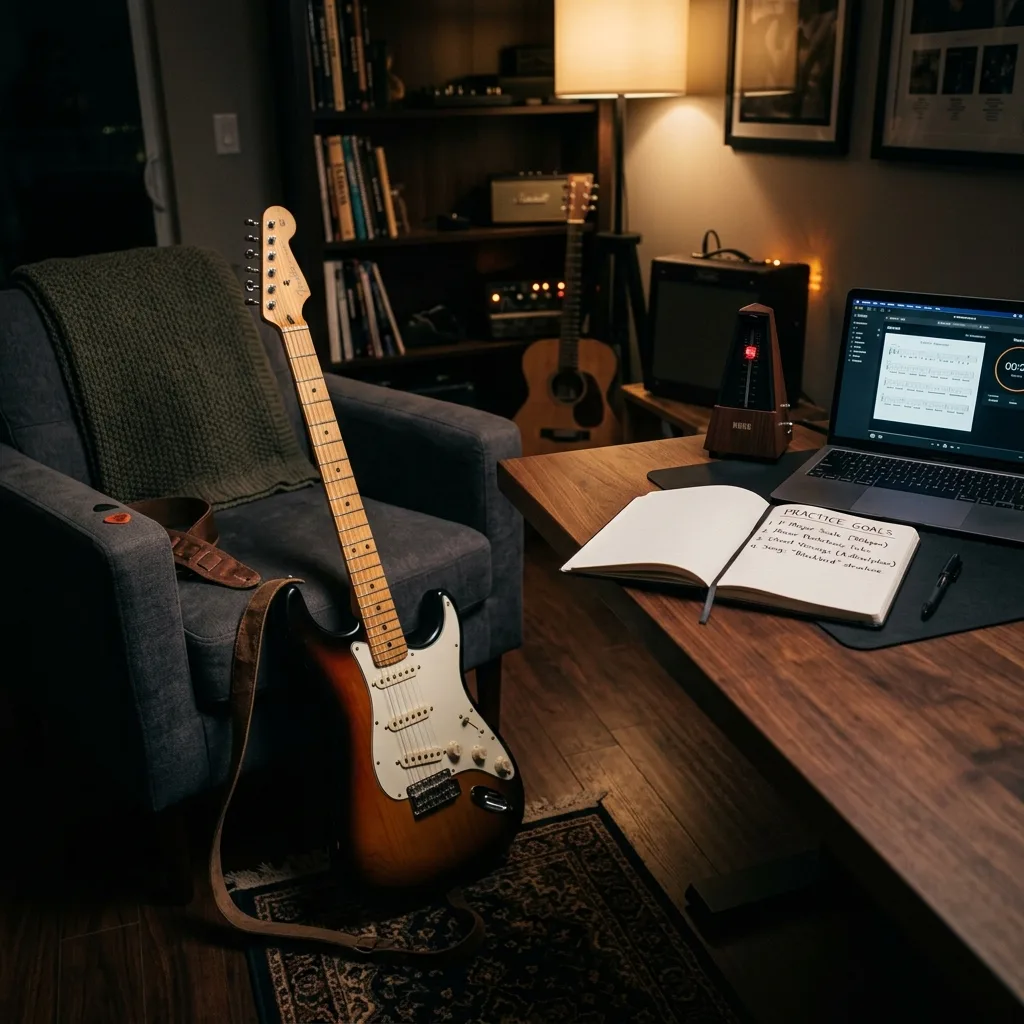
Guitar practice goal setting is the single most important habit separating guitarists who improve fast from those who spin their wheels for years. At Riff Quest, we've watched hundreds of players transform their practice sessions simply by getting clear on what they're working toward. Most beginners pick up the guitar with big dreams and zero plan. That gap between ambition and structure is where progress dies.
Here's what most guides get wrong: they tell you to "practice every day" without explaining what to practice or why. Consistent practice without clear goals is just repetition. And repetition without direction builds bad habits as easily as good ones.
Below, we'll show you exactly how to build a goal-setting system that works for beginners, intermediate players, and advanced guitarists alike. The framework covers SMART goals, practice routines, progress tracking, and how to push through the frustrating plateaus that kill motivation. If you're brand new, pair it with our 30-day beginner roadmap; if you're torn over what to prioritise, see skill goals vs. song goals.
Why Guitar Practice Goal Setting Changes Everything
Most guitarists practice the wrong things. They noodle through songs they already know, avoid the techniques that challenge them, and wonder why they're not improving after months of effort.
Guitar practice goal setting is the process of defining specific, measurable outcomes for your practice sessions so that every minute you spend with the guitar moves you forward. Without goals, practice becomes aimless. With them, even 20 minutes a day produces visible results.
The real shift happens when you stop thinking about practice as "playing guitar" and start treating it as skill-building. Those are different activities. Playing guitar feels good. Skill-building is often uncomfortable, slow, and repetitive. But it's the only thing that actually works.
According to research covered in Psychology of deliberate practice and skill acquisition, targeted practice with clear feedback loops produces dramatically faster improvement than unstructured repetition. This applies directly to learning guitar. The players who improve fastest aren't the ones who practice longest. They're the ones who practice most intentionally.
Three things change when you commit to proper goal setting:
- You know exactly what to work on each session
- You can measure progress instead of guessing
- You stay motivated because you can see yourself improving
That last point matters more than most people realize. Motivation follows progress. When you can't see improvement, frustration builds. When you can track it, discipline becomes easier.
SMART Goals for Guitarists: A Practical Framework
The popular advice here is wrong. Most guitar guides tell you to "set goals" without giving you a system that actually works in practice. Vague goals like "get better at guitar" or "learn more songs" are worse than useless because they give you nothing to aim at.
SMART goals for guitarists means making every goal Specific, Measurable, Achievable, Relevant, and Time-bound. This framework isn't new, but most players never apply it to their guitar practice.

Here's what each element looks like for guitar:
- Specific: "Learn the chord transitions in the first verse of Wonderwall" beats "practice chords"
- Measurable: "Play the G-to-C transition cleanly 10 times in a row at 80 BPM"
- Achievable: Set goals that stretch you without being impossible for your current level
- Relevant: Focus on skills that move you toward your bigger musical goals
- Time-bound: "By the end of this week" creates urgency that "someday" never does
The thing nobody tells you about SMART goals for guitar is that the time-bound element is the hardest to stick to. It's easy to push deadlines when nobody's holding you accountable. That's why writing goals down and reviewing them weekly makes such a big difference.
Write your weekly guitar goals on paper, not just in your head. The physical act of writing forces clarity. Vague ideas become concrete plans. Review them at the start of every practice session.
Breaking Down Long-Term Goals into Weekly Milestones
Long-term goals without milestones are just wishes. If your big goal is "play in a band by the end of the year," that's exciting but too distant to drive daily practice.
Break it down. Work backwards from the long-term goal to create short-term milestones that feel achievable right now.
A practical example:
- Long-term goal (6 months): Play three full songs confidently in front of other people
- Monthly milestone: Learn one complete song, including transitions and rhythm
- Weekly milestone: Master the verse chord progression at performance tempo
- Daily practice goal: Work on one specific chord change for 10 minutes
This structure turns an overwhelming target into a series of small wins. Small goals build momentum. Momentum builds consistency. Consistency builds skills.
The key is reviewing milestones weekly. Life changes. Your guitar skills develop unevenly. Some things click faster than expected. Others take longer. Adjust your milestones based on actual progress, not the original plan.
Goal Examples by Skill Level and Genre
A common mistake is using someone else's goals when your situation is completely different. A beginner learning acoustic folk needs different targets than an intermediate player working on blues lead guitar.
| Skill Level | Genre Focus | Example 3-Month Goal |
|---|---|---|
| Beginner | Acoustic/Pop | Learn 5 open chords, play 2 songs cleanly |
| Beginner | Classical | Play a simple fingerstyle piece with correct technique |
| Intermediate | Blues | Improvise over a 12-bar blues with pentatonic scale |
| Intermediate | Rock | Master alternate picking at 120 BPM on a 6-note pattern |
| Advanced | Jazz | Comp through a ii-V-I progression in 3 different keys |
| Advanced | Fingerstyle | Arrange and perform a complete fingerstyle piece |
Genre matters because it shapes which techniques and music theory concepts deserve your focus. A metal player needs to prioritize picking accuracy and palm muting. A jazz player needs chord voicings and ear training. Build your goals around the music you actually want to play.
Beginner Guitar Goals: Where to Start Without Overwhelm
Starting guitar feels overwhelming. There's so much to learn: chords, scales, strumming patterns, music theory, songs. Most beginners try to do everything and end up stuck on nothing.
The fix is brutally simple. Pick one thing. Work on it until it clicks. Then pick the next thing.
Solid beginner guitar goals follow this sequence:
- Learn the five core open chords: G, C, D, Em, Am
- Practice switching between two chords smoothly before adding a third
- Learn one strumming pattern and apply it to a simple song
- Add one new chord or technique per week once the basics feel solid
Notice what's not on that list. Scales. Music theory. Lead guitar. Those things matter, but not in week one. Beginners who chase too many skills at once build frustration, not technique.
A realistic beginner schedule looks like 15-20 minutes per day, split roughly between chord practice and a song you're learning. That's it. Short sessions with clear focus beat long sessions with no direction every time.
Don't skip the basics to learn impressive-sounding techniques early. Beginners who jump to solos before their chord transitions are clean will develop tension in their hands and inconsistent timing. These habits are hard to unlearn later.
The goal of beginner practice isn't to learn everything. It's to build the habit of showing up and the confidence that comes from visible progress.
Guitar Practice Routine Examples That Build Real Skills
What separates players who improve from those who plateau is structure. A good guitar practice routine isn't random. It has a clear shape, a timer, and a purpose for every block of time.
Here's a practical 30-minute routine for intermediate players:
- 5 minutes: Warm-up with chromatic exercises or scales at slow tempo
- 10 minutes: Focused technique work (picking accuracy, a difficult chord shape, legato runs)
- 10 minutes: Song learning or repertoire practice
- 5 minutes: Free play or improvisation
This structure works because it separates skill-building from enjoyment. The technique block is where real improvement happens. The song and free-play blocks keep practice fun and connected to your musical goals.
How to Structure Your Practice Time with a Timer
Most guitarists underestimate how much they drift during practice. They sit down to work on a chord change and end up playing through their favorite riff for 20 minutes. A timer fixes this immediately.
Set a timer for each block of your practice routine. When the timer goes off, move on. This forces focus and prevents you from spending all your time on comfortable material.
According to research on time-blocking and focused work habits, breaking work into timed intervals significantly improves output quality and reduces mental fatigue. The same principle applies directly to guitar practice.
A simple timer-based routine for beginners:
- Set timer for 5 minutes: chord transitions only
- Set timer for 5 minutes: strumming pattern on a song
- Set timer for 5 minutes: try to play through the song start to finish
- Reset and repeat or move to a different skill
The timer creates accountability you can't fake. Either you worked on the chord change for five minutes or you didn't.
Balancing Chords, Scales, Techniques, and Songs
The biggest question most players have about their practice routine is how to split time between different areas. The honest answer: it depends on your current weaknesses.
A rough starting framework:
- Beginner: 60% chords and transitions, 30% songs, 10% scales
- Intermediate: 30% technique, 30% songs, 20% scales, 20% theory or ear training
- Advanced: 25% composition or improvisation, 25% repertoire, 25% technique refinement, 25% music theory
Adjust based on what's actually holding you back. If your picking accuracy is the bottleneck, spend more time there. If you know lots of techniques but no complete songs, shift toward repertoire.
The worst approach is spending equal time on everything regardless of where you're weakest. That's how players stay average across all areas instead of becoming genuinely strong in the skills that matter most for their style.
How to Use a Tracking Guitar Progress App Effectively
Tracking guitar progress without a system is like training for a race without a watch. You feel like you're working hard, but you have no idea if you're getting faster.
A good tracking guitar progress app makes your improvement visible. It shows you which songs you've mastered, which techniques need more work, and whether you're building the daily consistency that produces real results.

Riff Quest is built specifically for this. It's a free platform that tracks your development across songs and techniques, with a detailed stats dashboard showing exactly where your practice time is going. The built-in library includes 144 technical exercises with animated tablature, so you're not just logging practice time. You're following structured exercises that actually build the skills you're tracking.
What makes Riff Quest different from generic habit trackers is the point and ranking system, which works like Guitar Hero for real guitar. That gamification element keeps daily practice feeling rewarding rather than like a chore.
To use any progress tracking app effectively, follow these habits:
- Log every session, even short ones. Streaks matter for motivation.
- Review your stats weekly, not just daily. Patterns emerge over time.
- Set specific technique goals inside the app so you can measure improvement objectively.
- Use the app to identify which areas you're avoiding. Neglected skills show up in the data.
According to behavioral science research on habit tracking and goal completion, people who track their habits are significantly more likely to maintain them long-term. Visible progress creates a feedback loop that reinforces the behavior.
Overcoming Plateaus, Frustration, and Practice Burnout
Every guitarist hits a wall. Progress feels fast at the start, then suddenly stops. You're practicing the same amount, but nothing seems to be improving. This is the plateau, and it's one of the most common reasons people quit guitar.
Here's the part most guides skip: plateaus usually mean your current practice routine has stopped challenging you. You've mastered the skills you've been working on, but haven't pushed into new territory. The solution isn't to practice more. It's to practice differently.
Signs you're in a plateau:
- You're playing through songs you already know instead of learning new material
- Your technique practice feels comfortable rather than difficult
- You're avoiding specific skills because they're frustrating
- You haven't set a new goal in weeks
The fix is to deliberately practice at the edge of your ability. That means working on things you can't do yet, not things you can almost do. It's uncomfortable. That discomfort is the signal that learning is happening.
Burnout is different from a plateau. Burnout means you've lost the desire to practice at all. When that happens, forcing yourself through structured sessions usually makes it worse. A better approach is to drop all goals for a week and just play whatever you feel like. Reconnect with why you love guitar in the first place.
After the break, come back with a fresh set of goals and a simpler routine. Accountability helps here too. Sharing your goals with a guitar teacher, a practice partner, or even an online community creates external motivation when internal motivation runs dry.
Plateaus are a sign of progress, not failure. They mean you've outgrown your current practice goals. Treat them as a signal to raise the difficulty, not quit.
Guitar Practice Goal Setting for Intermediate and Advanced Players
The mistake intermediate and advanced players make is applying beginner thinking to advanced problems. They set goals around learning songs when the real growth opportunities are in improvisation, composition, and style development.
At this stage, guitar practice goal setting shifts from "what can I learn?" to "what kind of player do I want to become?" That's a more interesting question, and it leads to more interesting practice.
Advanced players often benefit most from working with a guitar teacher who can identify blind spots they can't see themselves. A teacher provides structured feedback that no app or tutorial can fully replace. Even one lesson per month can dramatically accelerate progress when you're working at an advanced level.
Setting Goals Around Improvisation, Fingerstyle, and Composition
Improvisation goals are the hardest to set because the outcome feels vague. The key is to make them concrete through constraints.
Instead of "get better at improvising," try:
- "Improvise over a 12-bar blues in G using only the minor pentatonic scale for 10 minutes per session"
- "Create a 4-bar melodic phrase over a ii-V-I progression in three different keys"
- "Record a 2-minute improvisation each week and compare recordings over the month"
Fingerstyle goals work best when tied to specific pieces or techniques. Picking accuracy, thumb independence, and dynamics are all measurable. Set a target tempo for a specific passage and work toward it with a metronome.
Composition goals benefit from deadlines. "Write one 16-bar progression per week" is more effective than "start writing my own music someday." The constraint forces creative decisions instead of endless planning.
According to research on creativity and constraint-based thinking, creative constraints consistently produce better output than open-ended freedom. This is as true for guitar composition as it is for any other creative discipline.
What stands out at the advanced level is how much improvement comes from recording yourself. Most advanced players avoid listening back because it's uncomfortable. But recorded feedback reveals technique issues, timing problems, and musical weaknesses that feel invisible in the moment.
Inconsistent practice and unclear progress are what hold most guitarists back. Riff Quest addresses both directly. As a free platform, it tracks your songs, techniques, and practice streaks without the stress of complicated setup. The 144 built-in exercises with animated tablature give you structured material to work through, while the detailed stats dashboard shows exactly where your time is going. Start your guitar progress with Riff Quest and turn your next practice session into measurable improvement.
Turn Practice into Progress
Stop guessing and start growing. Use Riff Quest to track your sessions, master 144+ technical exercises, and see your skills improve with data-driven insights.
Start Tracking FreeFAQs
How do I set realistic guitar practice goals?
Start by assessing your current skill level honestly, then identify one or two specific areas to improve, such as chord transitions, picking accuracy, or learning a particular song. Break each goal into small, weekly targets you can realistically hit in your available practice time. Avoid vague goals like 'get better at guitar.' Instead, aim for something measurable: 'play the G-to-C chord transition cleanly at 80 BPM within two weeks.' Consistency matters more than ambition when it comes to guitar practice goal setting.
What are SMART goals for guitar practice?
SMART goals for guitarists are Specific, Measurable, Achievable, Relevant, and Time-bound. Instead of saying 'I want to learn fingerstyle,' a SMART goal would be: 'I will learn the fingerpicking pattern for one song at 60 BPM within 30 days, practicing 15 minutes daily.' This approach removes guesswork, keeps you focused during practice sessions, and makes it easy to measure real progress. SMART goals work for beginners learning open chords all the way to advanced players working on improvisation or composition.
What should a beginner guitarist's goals be?
Beginner guitar goals should focus on building a strong foundation without overwhelming yourself. Good starting targets include: learning five open chords (G, C, D, Em, Am), switching between two chords smoothly within 30 seconds, playing a simple song all the way through, and practicing consistently for 15-20 minutes per day. Avoid trying to tackle music theory, scales, and songs all at once. Pick one or two beginner guitar goals per month, track your progress, and celebrate small wins to stay motivated.
How do I track my guitar practice progress effectively?
The most effective way to track guitar progress is to log every session, recording what you practiced, the tempo you reached, and how it felt. A dedicated tracking guitar progress app like Riff Quest makes this easy by letting you monitor songs, techniques, and practice streaks in one place. A practice log also reveals patterns: which skills are improving, where you're stuck, and how much time you're actually investing. Reviewing your log weekly helps you adjust your guitar practice routine and stay accountable to your goals.
How do I stay motivated with my guitar practice?
Motivation in guitar practice comes from seeing visible progress, which is why goal setting and tracking matter so much. Set short-term milestones that lead toward bigger goals, finishing a song section, hitting a new tempo, or nailing a technique. Mix challenging exercises with songs you genuinely enjoy playing. Using a practice schedule with a timer prevents burnout by keeping sessions focused and manageable. If frustration sets in, revisit your practice log to see how far you've come, progress you might otherwise overlook.

.webp)