Vibrato — Low Position (Frets 1–5)
Develop controlled, wide vibrato in the lower frets with high string tension.
Tablature
Preview only. Log in to access the fully interactive version with playback, tempo control, and real-time feedback. Sign in →
Why It Matters
Fretting near the nut requires more physical force to modulate the string's pitch. This drill builds the foundational hand strength and wrist mechanics needed to execute clean, wide vibrato on low frets.
How to Practice
- 1Apply firm finger and wrist force to overcome the high string tension near the nut.
- 2Rotate your wrist wide, keeping the oscillation rhythmically even.
Tips & Techniques
- •Anchor your thumb securely behind the neck to leverage the wider wrist rotation.
- •Focus on keeping the oscillation width equal above and below the target pitch.
Skills You'll Develop
Ready to Practice?
Start practicing this exercise right now with our interactive tablature and real-time feedback.
Sound Recognition
Real-time audio recognition
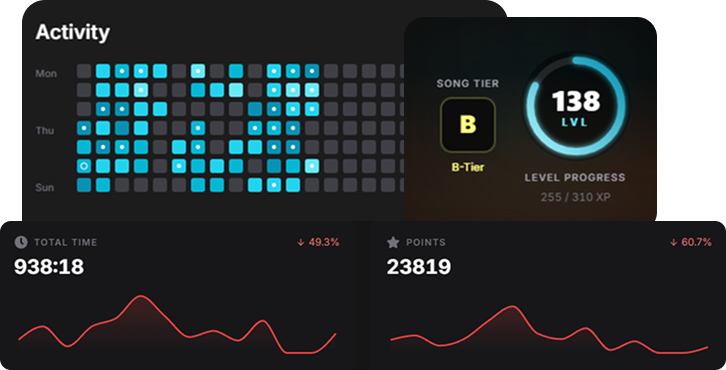
Analytics
Track your progress
Activity Heatmap
Visualize your streak
Real-time Feedback
Instant corrections
Related Exercises
Vibrato Sustain — Hold It for the Whole Bar
Sustain notes with continuous, even vibrato while executing precise rests to test control over pitch modulation.
Vibrato — High Position (Frets 12–17)
Adapt your vibrato technique to the narrow frets of the upper register.
Vibrato — One Finger at a Time
Isolate and develop controlled vibrato for each individual finger.
Muting Spotlight — Pick One, Kill the Rest
Isolate single notes while aggressively muting all adjacent strings under gain.