Vibrato Control
Control the speed, width, and depth of your pitch modulation by sustaining notes and bent pitches across multiple strings.
Tablature
Preview only. Log in to access the fully interactive version with playback, tempo control, and real-time feedback. Sign in →
Why It Matters
Sustaining clean vibrato requires maintaining uniform oscillation width and speed across different fretboard locations. Practicing vibrato on regular notes, during string changes, and on bent pitches develops the finger strength and forearm rotational control needed for high-level expression and pitch consistency.
How to Practice
- 1Sustain each note cleanly before starting a steady, controlled pitch modulation.
- 2Maintain consistent width and speed throughout the duration of the note.
- 3Keep the pitch modulation symmetric to ensure perfect intonation.
Tips & Techniques
- •Rotate your wrist and forearm to drive the vibrato rather than bending your finger joints.
- •Support the vibrating finger with adjacent fingers whenever possible for maximum control.
- •Maintain a relaxed thumb position behind the neck to avoid hand strain.
Skills You'll Develop
Ready to Practice?
Upgrade to Premium to unlock this exercise and master it with our guided practice tools.
Sound Recognition
Real-time audio recognition
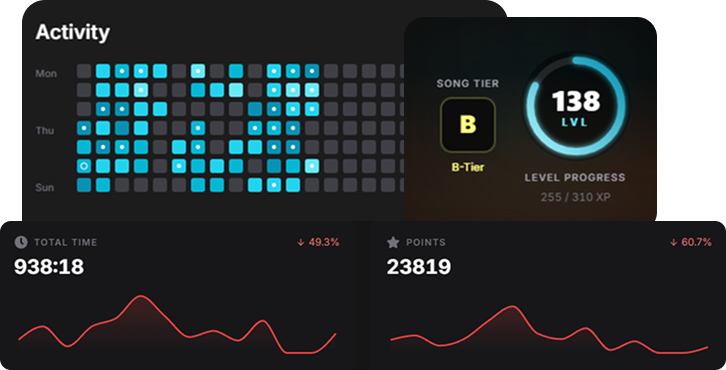
Analytics
Track your progress
Activity Heatmap
Visualize your streak
Real-time Feedback
Instant corrections
Related Exercises
Vibrato Sustain — Hold It for the Whole Bar
Sustain notes with continuous, even vibrato while executing precise rests to test control over pitch modulation.
Vibrato — Low Position (Frets 1–5)
Develop controlled, wide vibrato in the lower frets with high string tension.
Vibrato — High Position (Frets 12–17)
Adapt your vibrato technique to the narrow frets of the upper register.
Vibrato — One Finger at a Time
Isolate and develop controlled vibrato for each individual finger.