Tonal Palette Discovery
Explore the different sounds you can produce by varying pick location and angle.
Why This Exercise Matters
Your hands are the ultimate tone control. Picking near the bridge produces a bright, biting tone, while picking near the neck creates a warm, round sound. Developing control over these tone 'colors' adds massive expression to your playing.
How to Practice
- 1Play the same simple phrase in three different pickup positions:
- 21. Bridge position - bright, cutting tone with sharp attack.
- 32. Middle position - balanced, clear tone with good definition.
- 43. Neck position - warm, mellow tone with soft attack.
- 5Experiment with pick angle: perpendicular vs. angled attack.
- 6Try different pick depths: surface picking vs. deep digging.
- 7Listen carefully to how each variation changes the character of the sound.
Tips & Techniques
- •Bridge position = bright and aggressive, perfect for cutting through a mix.
- •Neck position = smooth and warm, ideal for jazz or blending with other instruments.
- •Middle position = the 'sweet spot' - versatile for most musical situations.
- •Pick angle affects tone: parallel to strings = mellow, angled = brighter.
- •Depth matters: shallow = glassy and clear, deep = chunky and aggressive.
- •Mark Knopfler uses picking position changes as a compositional tool.
- •Each position has a purpose in the sonic palette - learn when to use each.
- •Combine with dynamics for even more tonal variations.
Skills You'll Develop
Ready to Practice?
Upgrade to Premium to unlock this exercise and master it with our guided practice tools.
Sound Recognition
Real-time audio recognition
Analytics
Track your progress
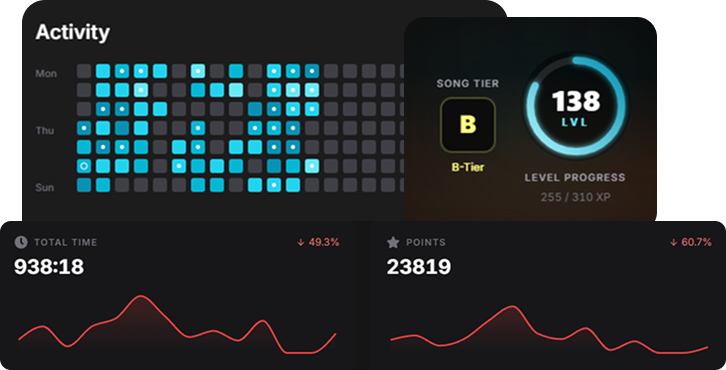
Activity Heatmap
Visualize your streak
Real-time Feedback
Instant corrections
Related Exercises
Single String Spider Exercise
Fret notes chromatic sequence on a single string to develop basic finger coordination and clean fretting hand accuracy.
Hammer-ons – 5-7-9 Sequence
Build finger strength and legato fluidity using wide-span hammer-ons.
Hammer-on Pentatonic Run – 3 Strings
Develop strong legato hammer-on technique and smooth cross-string transition fluidity across three strings.
Dark Pull-off Pentatonic Run
Develop seamless legato technique using A minor pentatonic pull-offs across the middle strings. Focus on dynamic equality between picked and pulled notes for a smooth, heavy flow.