Strumming Pattern 6 — Syncopated Upstroke
Execute a syncopated pattern featuring two consecutive sounding upstrokes.
Strumming Pattern
Strum direction pattern to practice.
Why This Exercise Matters
Consecutive upstrokes force you to rely entirely on the internal pendulum pulse, developing advanced syncopation and timing independence.
How to Practice
- 1Strum the pattern: Down, Miss, Down, Up, Miss, Up, Down, Miss.
- 2Ensure the upstrokes on '&2' and '&3' ring clearly while the downstroke on beat 3 is a silent swing.
Tips & Techniques
- •Maintain a continuous 8th-note pendulum motion with your strumming arm, ensuring the arm swings even during silent beats.
- •Start at a slow tempo (e.g., 60 BPM) and increase speed only when the coordination is precise.
- •Count the subdivisions aloud ('1 & 2 & 3 & 4 &') to lock your physical movement to the internal rhythm.
Skills You'll Develop
Ready to Practice?
Upgrade to Premium to unlock this exercise and master it with our guided practice tools.
Sound Recognition
Real-time audio recognition
Analytics
Track your progress
Activity Heatmap
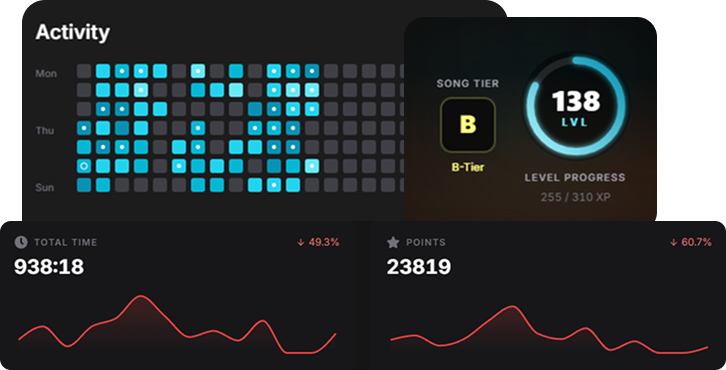
Visualize your streak
Real-time Feedback
Instant corrections
Related Exercises
Rhythm Training — Easy
Execute fundamental quarter and half-note rhythms on a muted string to establish a solid internal pulse.
Triplets Drill
Play three even notes per beat on a single string to master the feel and timing of triplet subdivisions.
Funk Rhythm Guitar
Master 16th-note scratching, clean accents, and tight left-hand muting.
Strumming Pattern 2 — Quarter Downs + Final Up
Execute four steady downstrokes with a single upstroke on the final subdivision.