Triplets Drill
Play three even notes per beat on a single string to master the feel and timing of triplet subdivisions.
Tablature
Preview only. Log in to access the fully interactive version with playback, tempo control, and real-time feedback. Sign in →
Why It Matters
This exercise programs the feel of three-note subdivisions (triplets) directly into your internal rhythm. It develops an even picking pulse, prevents rushing the third note, and establishes the essential hand coordination needed for odd-numbered divisions.
How to Practice
- 1Execute notes cleanly while suppressing all sympathetic string vibrations.
- 2Audit your dynamic consistency and attack angle using a clean tone.
- 3Transition between positions fluidly without disrupting the rhythmic grid.
Tips & Techniques
- •Mute low strings with your picking-hand palm and high strings with your fretting-hand index finger.
- •Ensure notes do not bleed together during chord transitions unless explicitly sustained.
- •Maintain an upright, relaxed posture to prevent muscle fatigue.
Skills You'll Develop
Ready to Practice?
Start practicing this exercise right now with our interactive tablature and real-time feedback.
Sound Recognition
Real-time audio recognition
Analytics
Track your progress
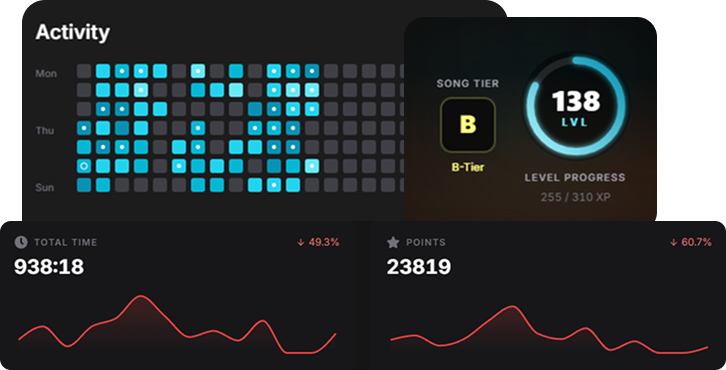
Activity Heatmap
Visualize your streak
Real-time Feedback
Instant corrections
Related Exercises
Rhythm Training — Easy
Execute fundamental quarter and half-note rhythms on a muted string to establish a solid internal pulse.
Funk Rhythm Guitar
Master 16th-note scratching, clean accents, and tight left-hand muting.
Strumming Pattern 2 — Quarter Downs + Final Up
Execute four steady downstrokes with a single upstroke on the final subdivision.
Strumming Pattern 3 — All Eighth Notes
Execute continuous alternate strumming on every 8th-note subdivision.