Pentatonic String Crossing — 3 Strings
Master the transitions between strings inside the pentatonic box. Focus on minimal pick travel to eliminate speed bottlenecks.
Tablature
Preview only. Log in to access the fully interactive version with playback, tempo control, and real-time feedback. Sign in →
Why It Matters
This exercise develops clean alternate picking across string changes. It improves your picking consistency, string transition control, and synchronization between both hands.
How to Practice
- 1Listen carefully to the reference sequence before reproducing it on the fretboard.
- 2Sing or hum the pitches aloud to reinforce the brain-to-fretboard connection.
- 3Transcribe the melody purely by ear, relying on relative interval recognition.
Tips & Techniques
- •Focus on the distance between notes rather than trying to guess absolute fret positions.
- •Practice without looking at your fretboard to build pure auditory-motor memory.
- •Start with simple three-note phrases before moving to complex arrangements.
Skills You'll Develop
Ready to Practice?
Start practicing this exercise right now with our interactive tablature and real-time feedback.
Sound Recognition
Real-time audio recognition
Analytics
Track your progress
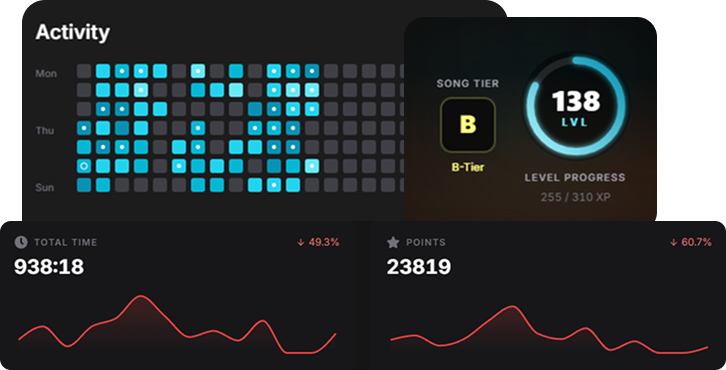
Activity Heatmap
Visualize your streak
Real-time Feedback
Instant corrections
Related Exercises
Single String Spider Exercise
Fret notes chromatic sequence on a single string to develop basic finger coordination and clean fretting hand accuracy.
A Pentatonic Alternate Picking — Position Drill
Practice pentatonic alternate picking using repeated notes per string to lock in hand synchronization and metronome timing.
String Skipping — 2 Notes Per String
Fret two notes per string and skip adjacent strings to develop precise picking hand spatial awareness.
Pentatonic Box 1 — Up and Down
Build basic scale navigation, alternate picking, and muscle memory.