Clean Tone — Slow Melody
Play a slow melody with a clean, plain sound to build a solid, even touch.
Tablature
Preview only. Log in to access the fully interactive version with playback, tempo control, and real-time feedback. Sign in →
Why It Matters
Use a plain, clean sound: an acoustic guitar as-is, or an electric on a clean setting with no added echo (reverb/delay) or distortion. A clean sound has nowhere to hide, so you can clearly hear how well each note sounds — its timing, its length, and how firmly you press the string.
How to Practice
- 1Play on an acoustic guitar, or on an electric with a clean sound and no added echo or distortion.
- 2Let each note ring for its full length, connecting them smoothly without gaps.
Tips & Techniques
- •Listen for buzzing, uneven volume, or notes that don't ring clearly, and press a little firmer to fix them.
- •Pick each string with the same steady strength so every note sounds even.
Skills You'll Develop
Ready to Practice?
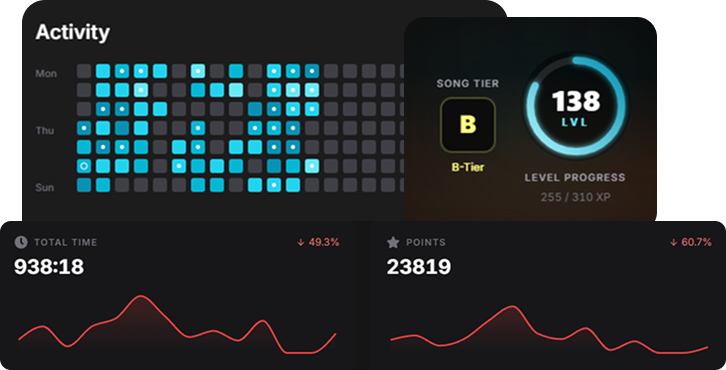
Start practicing this exercise right now with our interactive tablature and real-time feedback.
Sound Recognition
Real-time audio recognition
Analytics
Track your progress
Activity Heatmap
Visualize your streak
Real-time Feedback
Instant corrections
Related Exercises
Chromatic Accent Dynamics
Master your dynamic control by playing a chromatic sequence with shifting accents. You will learn to control your pick attack to make accented notes significantly louder and non-accented notes noticeably quieter.
Muting Discipline Drill
Eliminate unwanted string noise using systematic dual-hand muting.
Dynamic Range Control
Master the full dynamic spectrum of the guitar, from whisper-quiet to an aggressive attack. Control your picking depth and attack speed to match the required volume curves.
Iron Gallop — Thrash Rhythm Drill
Master precise, high-speed rhythmic galloping patterns.