Chord Spotlight — D Major Muting Drill
Strike a three-string D major triad while selectively muting specific strings with your fretting hand.
Tablature
Preview only. Log in to access the fully interactive version with playback, tempo control, and real-time feedback. Sign in →
Why It Matters
This exercise develops independent fretting hand tension control. By holding a full chord shape and selectively releasing pressure on specific fingers, you learn to mute unwanted strings without breaking your structural hand position—an essential skill for clean rhythm playing and funky percussive strumming.
How to Practice
- 1Maintain the D major chord shape throughout the entire exercise.
- 2To mute a note, release the pressure from that fretting finger while keeping it lightly touching the string.
- 3Strike all three strings simultaneously with a confident pick stroke on every beat, letting only the target note ring out.
Tips & Techniques
- •Do not lift your fingers completely off the strings when muting; simply relax the downward pressure to create a percussive thud.
- •The middle measure (isolating the second string) requires the most independence—practice the pressure change slowly without picking first.
- •Ensure your pick stroke covers all three strings equally, rather than trying to physically avoid the muted strings.
Skills You'll Develop
Ready to Practice?
Start practicing this exercise right now with our interactive tablature and real-time feedback.
Sound Recognition
Real-time audio recognition
Analytics
Track your progress
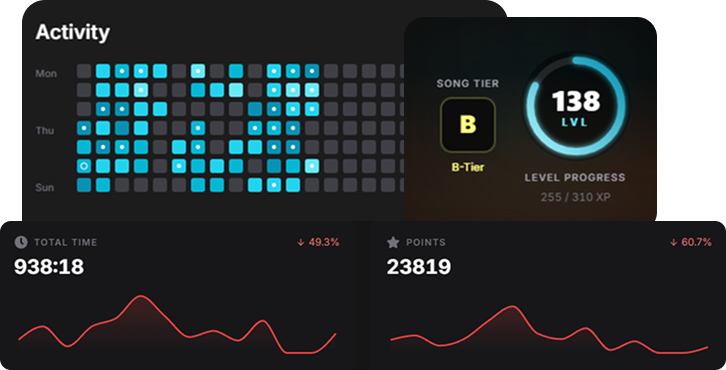
Activity Heatmap
Visualize your streak
Real-time Feedback
Instant corrections
Related Exercises
Muting Spotlight — Pick One, Kill the Rest
Isolate single notes while aggressively muting all adjacent strings under gain.
Vibrato Sustain — Hold It for the Whole Bar
Sustain notes with continuous, even vibrato while executing precise rests to test control over pitch modulation.
Vibrato — Low Position (Frets 1–5)
Develop controlled, wide vibrato in the lower frets with high string tension.
Vibrato — High Position (Frets 12–17)
Adapt your vibrato technique to the narrow frets of the upper register.