Finger Independence Exercise 1a
Isolate individual fingers of the fretting hand while keeping the others anchored.
Tablature
Preview only. Log in to access the fully interactive version with playback, tempo control, and real-time feedback. Sign in →
Why It Matters
Finger independence prevents secondary muscle tension and sympathetic finger movement. Developing isolated control over each finger ensures clean note execution, smoother transitions, and superior economy of motion during complex playing.
How to Practice
- 1Anchor the designated fingers firmly to the fretboard without squeezing.
- 2Move the active finger slowly and deliberately without letting the anchored fingers lift.
Tips & Techniques
- •Focus on eliminating sympathetic movement in the fingers immediately adjacent to the active one.
- •Keep your hand relaxed; carrying static tension makes isolation significantly harder.
Skills You'll Develop
Ready to Practice?
Start practicing this exercise right now with our interactive tablature and real-time feedback.
Sound Recognition
Real-time audio recognition
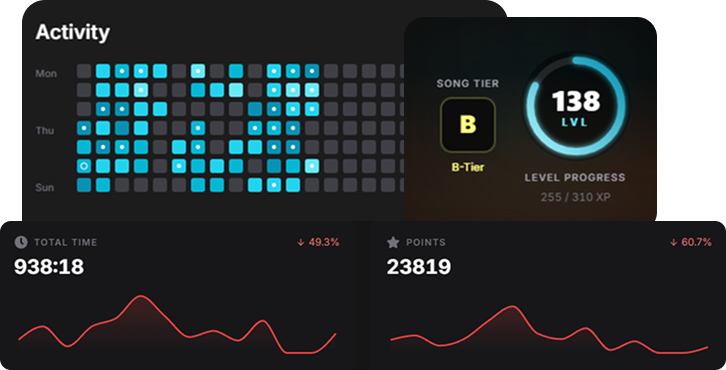
Analytics
Track your progress
Activity Heatmap
Visualize your streak
Real-time Feedback
Instant corrections
Related Exercises
Single String Spider Exercise
Fret notes chromatic sequence on a single string to develop basic finger coordination and clean fretting hand accuracy.
Petrucci Stretching Exercise
Expand your finger reach and hand flexibility with a wide-interval linear stretch.
Spider — One Note Per Beat
The classic 1-2-3-4 spider pattern slowed right down: one struck note on every metronome click, so you can focus purely on clean finger placement.
Advanced Spider Stairs Exercise
Fret non-adjacent string skipping patterns with wide interval leaps to build absolute finger independence and fingerboard stretch control.