Expressive Bend Phrasing
Integrate whole-step and half-step bends into melodic phrases with precise pitch control.
Tablature
Preview only. Log in to access the fully interactive version with playback, tempo control, and real-time feedback. Sign in →
Why It Matters
Bending is one of the most expressive techniques on the guitar, mimicking the human voice. Proper bending technique involves using the strength of multiple fingers and rotating the wrist to achieve perfect intonation and prevent string slippage.
How to Practice
- 1Support the bending finger with your adjacent fingers to maximize control and stability.
- 2Rotate your wrist and forearm rather than pushing with fingers alone to drive the bend.
Tips & Techniques
- •Listen closely to match the target pitch perfectly—do not under-bend or over-bend.
- •Keep pressure constant throughout the bend so the note does not die prematurely.
Skills You'll Develop
Ready to Practice?
Upgrade to Premium to unlock this exercise and master it with our guided practice tools.
Sound Recognition
Real-time audio recognition
Analytics
Track your progress
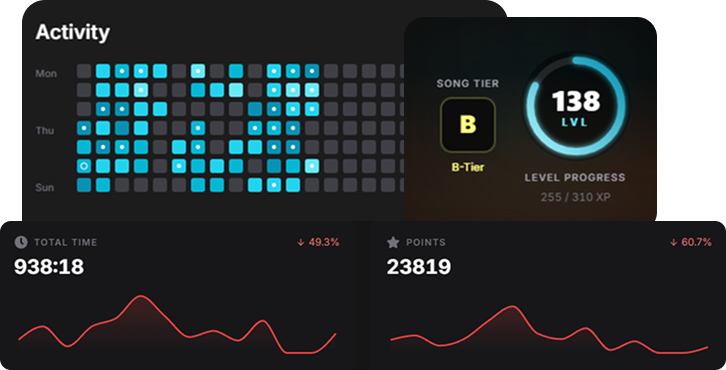
Activity Heatmap
Visualize your streak
Real-time Feedback
Instant corrections
Related Exercises
First Bend – Whole Step
Learn accurate whole-step string bending. Compare your bent pitch against reference notes to train both muscle memory and your ear.
First Bend – Half Step
Master the mechanics of half-step string bending with a focus on pitch accuracy.
Bend & Release
Perform clean whole-step string bends followed by slow, controlled releases to develop precise pitch control and finger strength.
High Register Bends – 15th Fret
Control string tension and achieve precise intonation when bending in the higher register.