First Bend – Whole Step
Learn accurate whole-step string bending. Compare your bent pitch against reference notes to train both muscle memory and your ear.
Tablature
Preview only. Log in to access the fully interactive version with playback, tempo control, and real-time feedback. Sign in →
Why It Matters
This exercise teaches you to target bent pitches by ear rather than guessing. It trains your muscle memory to hit the exact whole-step pitch perfectly every time, preventing flat or out-of-tune bends.
How to Practice
- 1Play the reference note first to lock the target pitch in your ear.
- 2Use your ring finger to bend, supported by your middle and index fingers behind it for strength.
- 3Push the string upward from your wrist until the pitch matches the reference note perfectly.
Tips & Techniques
- •Rotate your wrist to push the string — do not rely on finger strength alone.
- •Never bend with a single finger — always support the bending finger with other fingers behind it.
- •Listen carefully to the sustained pitch; push slightly harder if it starts to drift flat.
Skills You'll Develop
Ready to Practice?
Start practicing this exercise right now with our interactive tablature and real-time feedback.
Sound Recognition
Real-time audio recognition
Analytics
Track your progress
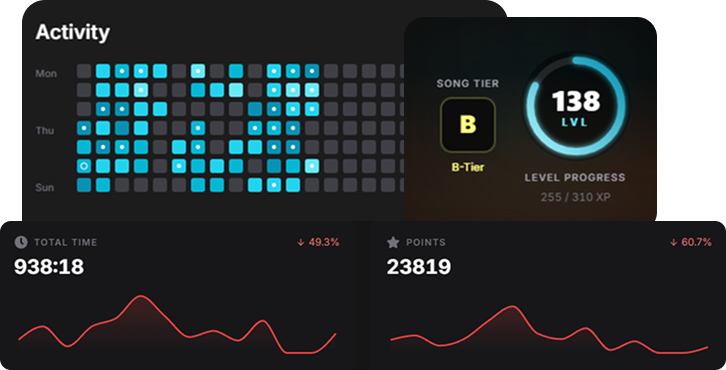
Activity Heatmap
Visualize your streak
Real-time Feedback
Instant corrections
Related Exercises
First Bend – Half Step
Master the mechanics of half-step string bending with a focus on pitch accuracy.
Bend & Release
Perform clean whole-step string bends followed by slow, controlled releases to develop precise pitch control and finger strength.
High Register Bends – 15th Fret
Control string tension and achieve precise intonation when bending in the higher register.
Precision Bend & Release
Develop precise whole-step bending and control. Follow the reference notes to train your ears, and master slow, controlled releases back to the starting pitch.