Call and Response Phrasing
Improvise contrasting pairs of musical phrases to structure guitar solos into clear questions and answers.
Backing track required
This exercise is designed to be practiced over a backing track or drone. Without one, you lose the harmonic context that makes the exercise effective — pick any backing track in the key of your choice and keep it looping throughout the session.
Why This Exercise Matters
This exercise develops structural phrasing and melodic storytelling during improvisation. By forcing you to separate solos into distinct pairs of 'questions' (tense/unresolved) and 'responses' (resolved), you learn to use pauses effectively, build and release tension logically, and keep your listeners engaged.
How to Practice
- 1Play a short, 1-2 measure 'question' phrase that ends on an unresolved interval (such as a 2nd or 5th).
- 2Leave a clear, silent pause to let the musical tension hang in the air.
- 3Play an 'answer' phrase that resolves cleanly back to a chord tone (such as the root or 3rd).
Tips & Techniques
- •Do not try to play constantly — silence is what defines the separation between your musical ideas.
- •Vary the rhythm or length of the response to create immediate contrast with the question.
- •Stay within a single scale shape initially to focus entirely on rhythmic phrasing and structural contour.
Skills You'll Develop
Ready to Practice?
Upgrade to Premium to unlock this exercise and master it with our guided practice tools.
Sound Recognition
Real-time audio recognition
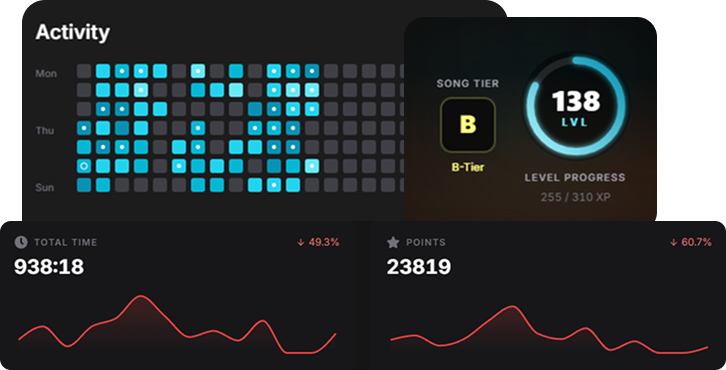
Analytics
Track your progress
Activity Heatmap
Visualize your streak
Real-time Feedback
Instant corrections
Related Exercises
Single String Phrasing
Improvise over a backing track while physically restricting your playing to a single string.
Single Chord Improvisation
Explore the full expressive and modal potential of a static chord.
Improv Prompts — Medium
Improvise over a backing track while rapidly adapting to rotating musical and theoretical constraints.
Two-Notes-Per-Bar Phrasing
Create expressive phrases restricted to exactly two notes per measure.