On this page
A beginner guitar practice checklist covers six daily essentials: 15–30 minutes of practice time, a distraction-free setup with your guitar, tuner, and metronome within reach, a 5–15 minute warm-up using chromatic scales and finger stretches, basic open chords like G, C, D, and Em practiced until transitions feel smooth, a simple strumming pattern such as "Down, Down, Up, Up, Down, Up," and beginner-friendly scales like C Major and E Minor Pentatonic for finger strength and fretboard knowledge. Working through warm-up, chords, strumming, and scales in that order, then applying them to a simple song progression like G-C-D-Em, turns loose practice time into a repeatable daily routine that builds confidence and muscle memory without burning you out. Here's the quick-reference version:
- Practice Time
- 15–30 minutes daily is better than long, occasional sessions.
- Setup
- Keep your guitar accessible, tools like a tuner and metronome nearby, and eliminate distractions.
- Warm-Up
- Spend 5–15 minutes on exercises like chromatic scales and finger stretches to prevent injuries and improve coordination.
- Chords
- Begin with basic open chords (like G, C, D, Em) and practice smooth transitions.
- Strumming
- Start with simple patterns like “Down, Down, Up, Up, Down, Up” before adding complexity.
- Scales
- Learn beginner-friendly scales like the C Major and E Minor Pentatonic to develop finger strength and fretboard knowledge.
- Songs
- Use simple progressions like G-C-D-Em to apply your skills and make practice enjoyable.
Want the specifics for your level? See our full breakdown by skill level for what changes as you progress past the beginner stage.
Pro Tip: Track your progress with tools like Riff Quest to stay motivated and measure improvement.
Even short, consistent sessions can lead to big results over time. Ready to get started? Grab your guitar and dive in!
Beginner Adult Guitar Routine 2025 | Step-by-Step Practice
Setting Up Your Practice Space
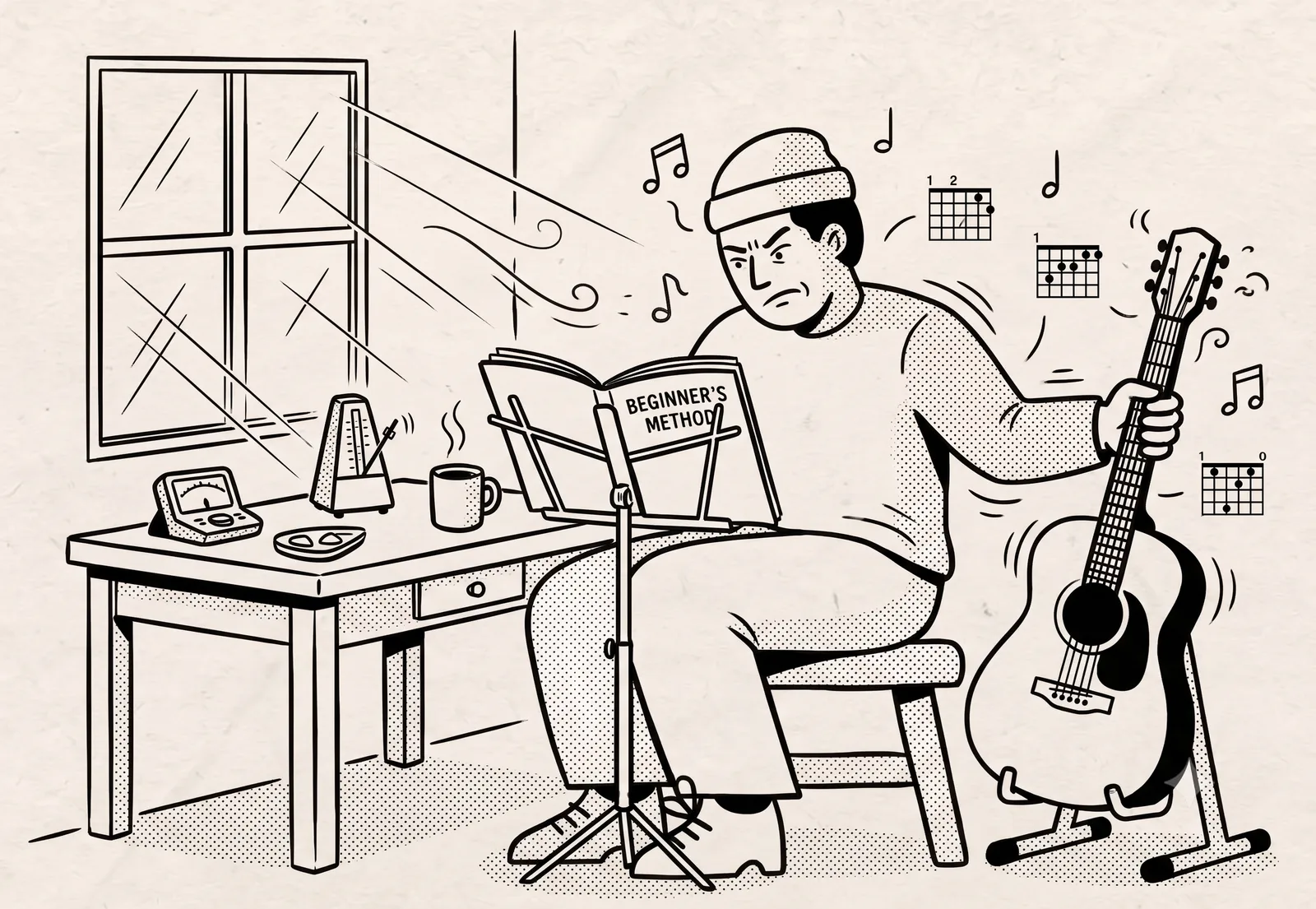
An accessible practice space removes the friction that makes you skip a session - the more steps it takes to get started, the less likely you are to actually start practicing[5].
Keep your guitar on a stand where it's always visible, and keep your tools within reach.
I keep my own guitar on a stand right next to my desk instead of in its case, and that one change alone doubled how often I actually picked it up.
Gather Your Practice Tools
Tools to keep near your practice space:
- Tuner: Essential for keeping your guitar in tune and training your ear[5].
- Metronome: Helps develop your timing, a must for playing with others[6]. A free online metronome in the browser is enough to start.
- Music Stand: Keeps your materials at eye level, reducing neck strain.
- Notebook or Journal: Handy for tracking lesson notes and progress[6].
If you use phone apps for tuning or a metronome, switch to airplane mode to avoid distractions.
Electric guitar players should keep their amp, pedals, and cables plugged in and ready to go.
Maintain Proper Posture
Use a firm chair or stool without armrests - regular desk chairs get in the way of the guitar body and limit your movement[5].
Sit upright with your back straight, and keep your wrist in a neutral position; awkward angles can lead to issues like Carpal Tunnel Syndrome[3].
For your fretting hand, place your thumb behind the neck, roughly opposite your middle finger, to reduce tension and improve technique[8].
Take short breaks every 15 to 20 minutes to shake out your hands and prevent fatigue[3].
If you're struggling to press down the strings, your guitar's action might be too high - getting it professionally adjusted can make a big difference[3].
Daily Warm-Up Exercises
Guitar playing puts repetitive strain on your hands, fingers, and wrists, so warming up matters. As Adam Perlmutter, Editor at Acoustic Guitar, puts it:
"Like it or not, playing the guitar is an athletic endeavor. Just like any sport or exercise... a guitarist should warm up before delving into practice or performance." [10]
Spend 5 to 15 minutes warming up - it prevents injuries, boosts blood flow to your fingers, and sharpens focus[9].
Key tip: never stretch cold muscles - start with light movement to warm your hands before transitioning into stretches.
I learned this the hard way after skipping warm-ups through a stretch of late-night sessions and ending up with a sore wrist for a week - five minutes of warming up now feels like cheap insurance.
Chromatic Scale Exercises
The "1-2-3-4" chromatic walk works both hands in unison and builds coordination:
- On the low E string, play frets 1, 2, 3, and 4 with fingers 1, 2, 3, and 4, using alternate picking (down-up strokes).
- Repeat the same pattern across all six strings.
Keep the tempo slow - start at 60 BPM on a metronome to focus on precision.
Finger Independence Drills
The "Spider" exercise improves finger independence by working non-adjacent fingers. For example:
- Play fingers 1 and 3 on the G string.
- Follow with fingers 2 and 4 on the B string.
Experiment with different finger combinations, and practice slowly to maintain clarity and avoid tension[2].
Hand and Wrist Stretches
Stretches help relieve tension and reduce the risk of repetitive strain injuries. Try these:
- Extend your arm with your palm facing down, then gently pull your fingers back with your other hand for 30 seconds.
- Repeat the same stretch with your palm facing up.
- For a deeper stretch, pull each finger back toward your forearm one at a time, holding each for 15 to 30 seconds [9] [8].
Learning Basic Chords
The first step in learning guitar is mastering open chords - chords that include at least one string played without pressing down a fret, giving them a rich, resonant sound with minimal effort. Open chords set the stage for playing countless songs and make advanced techniques easier to learn later.
For beginners, the most important open chords are often called the "Big 8": C Major, A Major, G Major, E Major, D Major, A Minor (Am), E Minor (Em), and D Minor (Dm).
Each of the Big 8 has a chord diagram and a string-by-string clarity check in the guitar chords for beginners guide.
Core Open Chords
Start with E Minor and G Major - two of the easiest chords to learn. E Minor only needs two fingers, making it a great confidence builder, while G Major uses your middle, ring, and pinky fingers, leaving your index finger free for smoother transitions.
Press with your fingertips close to the fret (but not on it) to avoid buzzing.
After strumming any open chord, pluck each string individually to check it rings clearly - adjust your fingers or arch your hand if one is muted.
For D Major, strum only the top four strings; skip the low E and A.
A useful drill is the "Finger Pushup": fret the chord, apply light pressure for half a second, relax without lifting your fingers, and repeat 10 times.
To improve transitions, focus on pivot fingers - fingers that stay in place as you switch chords (for example, your ring finger anchoring a C-to-G switch).
Try the "1-Minute Change Challenge": set a timer for 60 seconds and count clean switches between two chords - aim for 30 changes per minute.
Basic Strumming Patterns
Once you're comfortable switching chords, add rhythm. A popular beginner pattern for 4/4 time is "Down, Down, Up, Up, Down, Up" (D D U U D U). Keep your wrist loose and use small, controlled movements instead of your whole arm.
If strumming while changing chords feels tricky, practice your strumming pattern on muted strings first so you can focus on rhythm alone.
Practicing Scales and Techniques
Scales strengthen your fingers, sharpen picking accuracy, and unlock the fretboard. As Mike Duffy from Fender explains:
"Guitar scales are organized sequences of notes played in an ascending or descending order that help you build finger strength and dexterity" [13].
C Major and E Minor Pentatonic Scales
A great place to start is the C Major scale (C-D-E-F-G-A-B) - no sharps or flats, so it's easy to understand[13]. Start slow at 40–60 BPM with alternate picking; saying each note out loud as you play helps map out the fretboard[15].
Next is the E Minor Pentatonic scale (E-G-A-B-D) - the "ground zero for soloing" in rock and blues, and a beginner-friendly five-note scale using open strings and the first few frets[13]. Start in open position, then move to the fifth position to strengthen your fretting hand[15].
Once you can play a scale three times without mistakes, bump the metronome up by 5 BPM[3].
Once memorized, challenge yourself by reversing direction or playing in thirds[14].
Basic Arpeggios
Arpeggios ("broken chords") play a chord's notes one at a time instead of strumming them together[16]. Start with triad arpeggios like C Major (C-E-G) and A Minor (A-C-E) - they sharpen note clarity and train your ear to recognize chord structures[18].
Play each arpeggio slowly, low to high, at a comfortable metronome pace (60–80 BPM), then shift the fingering pattern up or down the neck once you're confident.
Once these patterns feel automatic, our full guide on how to practice guitar scales effectively covers the metronome drills and weekly schedule that take scales from beginner shapes to real speed.
Playing Simple Songs
Combine chords and scales into full songs to put your practice into action. A great starting point is the G-C-D-Em progression (the I-VI-IV-V progression) - a staple across genres that unlocks a huge catalog of songs using simple open chord shapes[19] [20].
Songs with G-C-D-Em Progressions
Pick songs in 4/4 time featuring these chords, and focus on clean, smooth transitions. Don't add strumming until your chord changes are fast enough to keep the rhythm even[4].
Start with silent switching - moving your fretting hand between chord shapes without strumming - to build muscle memory[11].
Use the pivot finger technique, and aim to place all your fingers on the next chord shape simultaneously[12] [22].
When you start strumming a song, begin with all-downstrokes (D D D D), then try a down-up pattern (D U D U)[23] [24].
A useful trick is the 2-beat rule: strum the current chord for two beats, then use the next two beats as "travel time" to shift to the next chord[21].
Use a one-minute switching drill: count how many clean changes you can make between two chords, like G and Em, in 60 seconds - beginners should aim for 30 changes per minute[4].
Once a handful of songs in this progression feel solid, browse songs by difficulty to find what to learn next without guessing whether it's too hard.
Tracking Progress with Riff Quest

Once warm-up, chords, strumming, and scales turn into a daily habit, the hard part stops being "what do I practice" and becomes "did I actually sit down and do it." That's what a practice tracker is for. For the full system - what to log, how often to review it, and the mistakes that quietly kill most practice logs - see how to track your guitar practice progress effectively.
Riff Quest is a free platform - no subscriptions, hidden fees, or credit cards - where you can log the exact routine above and watch it add up. Over 2,800 guitarists already use it to turn daily practice into measurable growth[25].
How long does a logged Riff Quest session actually run?
57 min
Mean length of a completed practice session.
- Sample:
- every completed practice report logged by 2,800+ players — 8,000+ sessions in total — measured 24 August 2026.
- Unit:
- one logged session, not one person's day. Someone who practises twice on a Tuesday appears twice.
- Duration:
- the total time recorded on that session, summed and divided by the session count.
We publish the mean and nothing else because the mean is all the aggregate returns. There is no median here, and no split by skill level, because neither is measured — and a mean of this shape is easily pulled upward by a minority of long sessions, so read it as “what the total divided by the count comes to”, not as “what a typical session looks like”.
Logging Your Warm-Ups, Chords, and Scales
Riff Quest's Report Practice feature logs each piece of the routine above - warm-up drills, chord changes, strumming, scales, or a full song - with a built-in timer, so your 15–20 minutes actually get counted.
Don't feel like planning the checklist yourself every day? Generate Session builds one from the same building blocks automatically, or pull a routine from the community-rated song library instead.
Progress is tracked across Technique, Theory, and Ear Training, so you can see which part of today's session is actually moving the needle.
Streaks Keep the Habit Alive
Consistency is the whole point of this checklist, and streaks are what make it visible: one Riff Quest guitarist has logged a 168-day practice streak, and only 1.6% of users have ever kept one going for a full week.
168 days
the longest streak on Riff Quest
1.6%
of users have ever kept a 7-day streak
Riff Quest streak data, logged practice sessions, July 2026
Daily quests, XP for every logged session, an activity heatmap, and unlockable achievements like "Elite Master" add small nudges to keep going on the days your motivation runs low.
Use skill-specific analytics to see which part of the routine - warm-up, chords, or scales - needs more attention next time.
Sample 15-20 Minute Daily Checklist
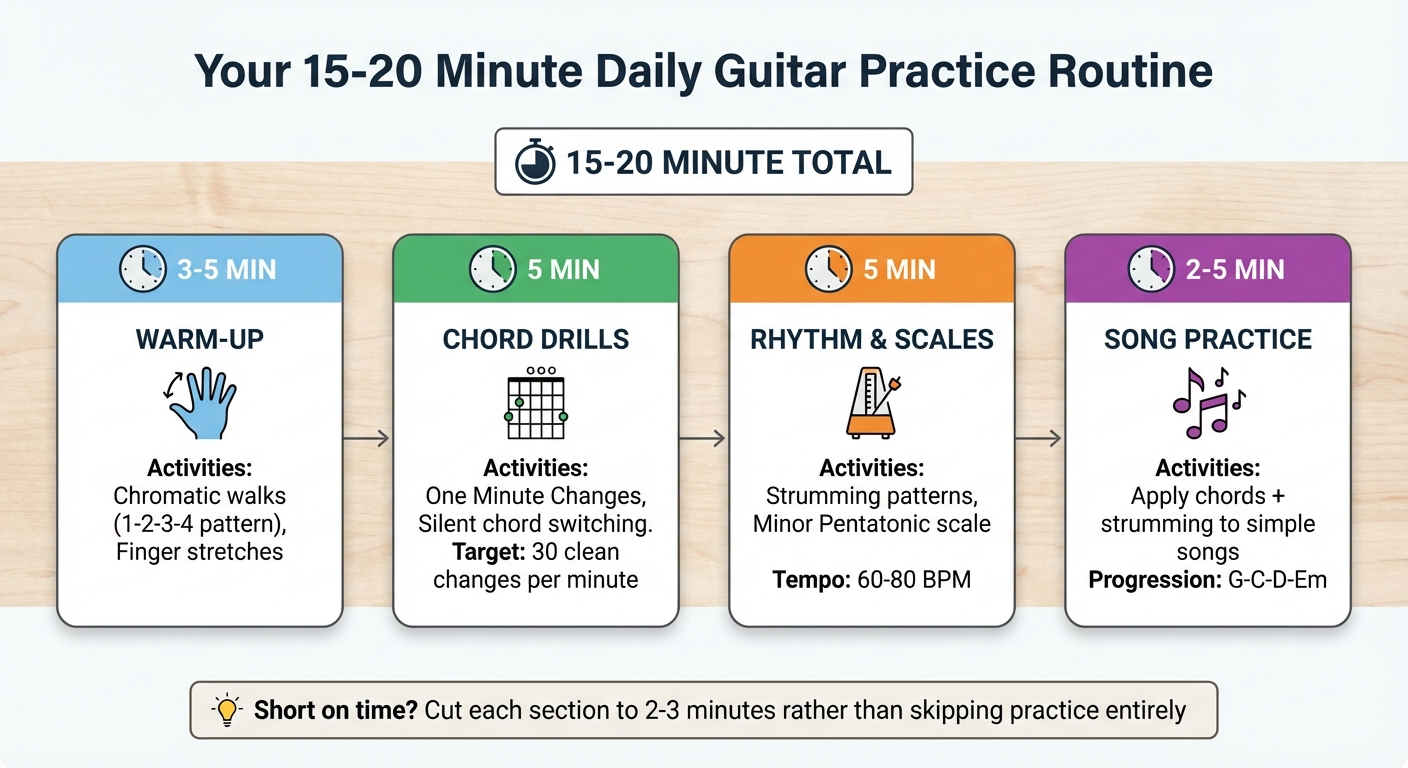
Whether you log it in an app or just run through it from memory, a focused 15–20 minute session, split into key activities, beats occasional marathon sessions. Here's how to structure the session:
| Activity | Time | Focus |
|---|---|---|
| Warm-Up | 3–5 minutes | Chromatic walks (like the 1-2-3-4 pattern) or simple finger stretches. |
| Chord Drills | 5 minutes | Practice "One Minute Changes" or silently switch between chord shapes. |
| Rhythm & Scales | 5 minutes | Work on strumming patterns or run through the Minor Pentatonic scale. |
| Song Practice | 2–5 minutes | Combine your chords and strumming with a simple song. |
Short on time? Cut each activity in your daily checklist to 2–3 minutes rather than skipping practice altogether - regular short sessions keep your momentum going.
Use a metronome during every drill, and wrap up your session with a favorite riff instead of an exercise. Ending on something you enjoy playing is what makes you want to pick the guitar up again tomorrow.
Got extra time? Stretch each activity in your checklist a little longer while keeping the same order.
Conclusion
A focused 15–20 minute practice session leads to noticeable improvement - you don't need to practice for hours, just the right things, every day[7].
The 15–20 minute daily checklist takes the guesswork out of your routine.
Even on hectic days, a shorter version of your routine keeps your progress intact.
Consistency is the one thing that actually moved the needle for me - the days I stuck to just 15 minutes did more for my playing than any occasional two-hour weekend binge[3].
Start tomorrow with a simple plan: warm-ups, chord transitions, and an easy song.
Record your efforts in tools like Riff Quest to see how far you've come. As Dr. Robin Alexander of Guitarmetrics puts it:
"Every great guitarist started with clumsy fingers and buzzing strings. What separates them from those who quit is the habit of showing up daily." [1]
Set a timer for 15 minutes and dive in. Your future self will be grateful!
FAQs
How do I know what to practice first each day?
Start with warm-up exercises - finger dexterity drills or basic chord changes - to get your hands ready. Then move to the essentials: scales, chord progressions, or a simple song.
A structured routine with clear goals keeps you consistent and makes each session productive.
What should I do if my fingers hurt or my wrist feels strained?
Check your technique first - press the strings only as firmly as necessary and keep your fingers close to the frets.
Warm-ups like finger stretches and chromatic scales help loosen your hands before playing.
If discomfort persists, consider lowering your guitar's action or switching to lighter strings, and take breaks as needed.
When should I increase my metronome speed?
Only increase the tempo once you can play the exercise or song comfortably at the slower pace without mistakes.
Starting slow builds accuracy and control; bump the metronome up in small steps once you're playing smoothly and with confidence.
About the Author

Michael Apfel
Guitarist & Creator of Riff Quest
Has been playing guitar for 14 years, including time performing live in two bands. Built Riff Quest to solve his own practice-tracking problems, and writes about practice and learning guitar drawing on hands-on experience with the instrument.
Try Riff Quest