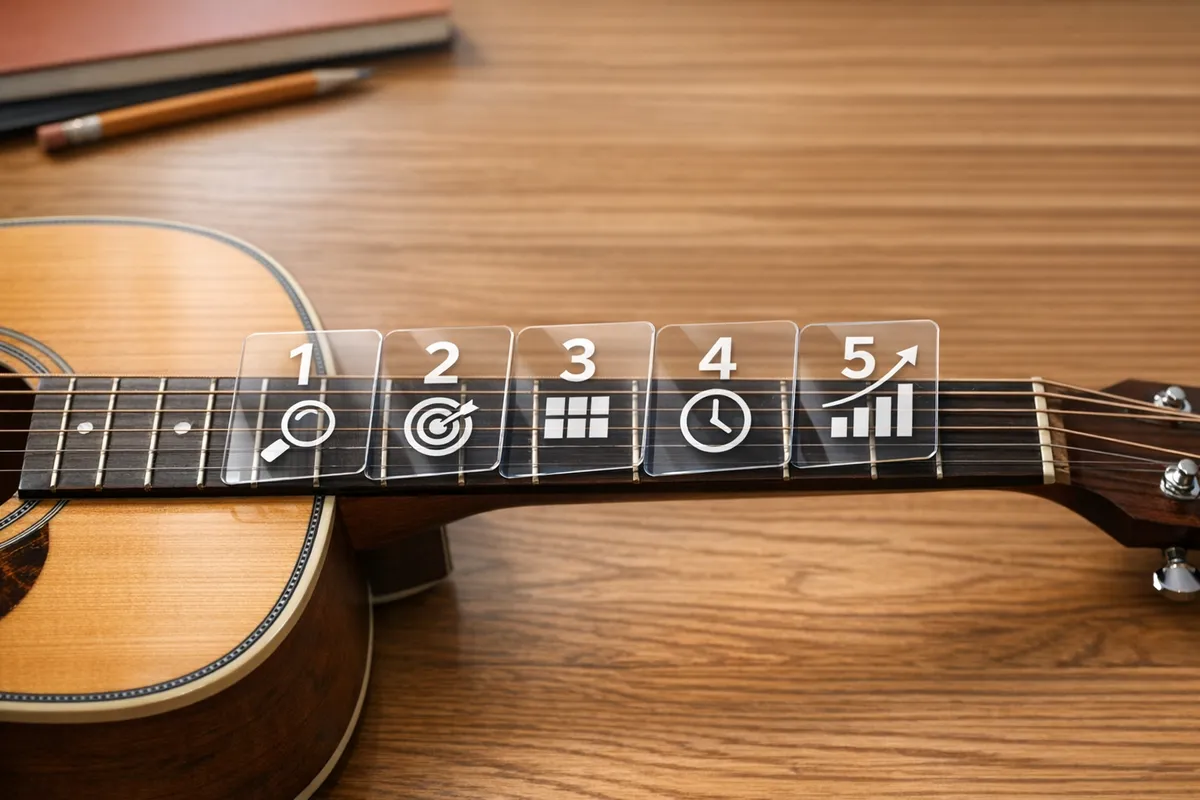
Want to improve your guitar skills without feeling overwhelmed? Here's how: Break down your practice routine into focused, manageable steps. Use these 5 strategies to add new techniques seamlessly:
- Review Your Current Practice Routine: Track how you're spending your time and spot areas for improvement.
- Pick One Skill and Break It Down: Focus on a single technique, like chord transitions or rhythm, and split it into smaller steps.
- Create Practice Exercises: Apply the skill to real songs to make practice more engaging.
- Set Aside Time: Dedicate short, focused sessions (10–15 minutes daily) to the new skill.
- Track Progress: Use tools or logs to measure improvement and adjust your practice plan as needed.
Consistency and structure are key. Tools like Riff Quest can help you stay organized, track progress, and keep practice fun with gamified rewards. Start small, stay focused, and watch your skills grow!
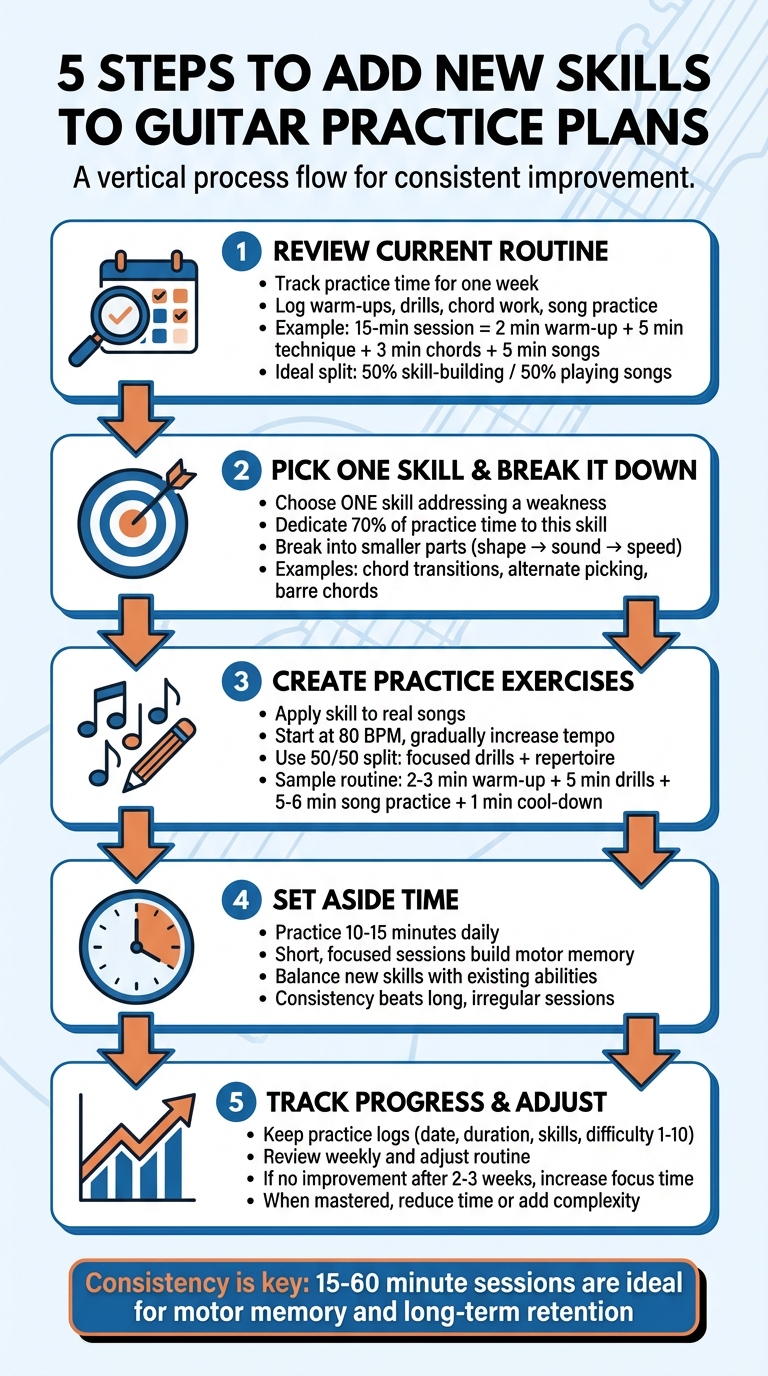
Consistency is the real game-changer. Short, intense practice sessions of 15 to 60 minutes are ideal for building motor memory.
Step 1: Review Your Current Practice Routine
Check How You Spend Your Practice Time
Spend a week logging your practice sessions. Track how much time you dedicate to warm-ups, drills, chord work, song practice, and improvisation. For example, a 15-minute session might break down into 2 minutes of warm-ups, 5 minutes on technique drills, 3 minutes on chord exercises, and 5 minutes practicing a song.
Many guitarists realize they spend more time on aimless improvisation than on focused exercises. A balanced routine typically splits practice time evenly: half on skill-building (like scales, chords, or technique) and half on playing songs or improvising. If your sessions lean heavily toward unstructured playing, it’s a sign you might need to focus more on developing specific skills. Reviewing your habits will help you spot areas where new techniques can be incorporated.
Find Areas That Need Improvement
Compare your practice logs to your actual performance. For instance, you might have clean chord shapes but struggle with rhythm consistency or slow chord transitions. These are common issues, often stemming from insufficient practice with strumming patterns or scales. Use your logs to identify where your practice routine isn’t translating into better performance.
Tools like Riff Quest's skill-specific analytics can give you precise insights into weak spots, whether it’s alternate picking speed, chord changes, or rhythm accuracy. This data can guide you in targeting specific areas. For example, if rhythm issues are keeping you from playing with others, dedicate extra time to improving that skill. Focus on addressing one area at a time rather than overwhelming yourself by tackling everything at once.
Step 2: Pick a New Skill and Break It Down
Choose One Skill to Focus On
Start by selecting a single skill that directly addresses a weakness you pinpointed in Step 1. For example, if you struggle with smooth transitions between chords, focus on chord changes. If keeping rhythm is tricky, dedicate time to alternate picking. For beginners, open chords like G, C, and D major are a great starting point. Meanwhile, intermediate players might aim for barre chords or pentatonic scales to push their abilities further.
Using tools like Riff Quest's song difficulty ratings can be a smart way to decide. These ratings highlight techniques used in songs at your level, making it easier to zero in on what to practice. For instance, if a Tier 2 song requires clean D-to-G transitions, make that your focus. This way, your practice directly ties to the music you want to play, rather than feeling like an unrelated drill.
To see faster improvement, dedicate about 70% of your practice time to this one skill. Whether you’re practicing for 10 minutes or 30, stick to a single focus during each session. Once you’ve chosen your skill, the next step is to break it into smaller, actionable parts.
Split the Skill into Smaller Parts
Breaking a skill into smaller, manageable steps makes practice feel less overwhelming and helps you track progress. Let’s take chord transitions as an example. You could divide the process into the following:
- Master the chord shape: Focus on accurately placing your fingers on a chord like D major, using the "three S's" - Shape, Sound, and Speed.
- Play single-chord arpeggios: Check that every note rings out clearly.
- Practice transitions: Move between two chords, like D and G, at 80 BPM.
- Add rhythm: Once the transitions feel smooth, layer in a strumming pattern.
For alternate picking, you might follow a sequence like this:
- Play a chromatic scale: Practice ascending and descending at 80 BPM.
- Work on major scale patterns: Use a metronome and stick to strict up-and-down strokes.
- Build consistency: Focus on groups of four notes to refine control.
- Apply it: Incorporate the pattern into a simple riff to connect the skill to actual music.
Step 3: Create Practice Exercises
Apply the Skill to Real Music
Now that you've broken down your new skill, it's time to weave it into your practice routine. The best way to do this? Apply the skill to songs you already know. This keeps practice sessions engaging and helps you see exactly how the technique fits into a musical context. For example, if you're focusing on alternate picking, take a familiar tune and tweak parts of it to include alternate picking. Start slow - say, at 80 BPM - and gradually increase the tempo. Similarly, if you're working on string skipping, you could experiment with Aerosmith's "Walk This Way." Adjust the opening riff to include string skips (like 6-4-3-1) and practice it at a relaxed tempo before speeding up.
A common 30-minute routine showcases this method: Start with picking exercises, move on to practicing the G major scale and D chord using the shape/sound/speed method, and then apply your new skill to a song like "Knockin' on Heaven's Door". This practical approach makes your practice sessions both structured and rewarding.
Use Guided Routines
To take things further, platforms like Riff Quest offer guided routines that make skill-building even easier. For instance, if you're tackling fingerstyle, you can break it down into specific drills, such as thumb-independence exercises, and then incorporate those drills into a song like "Dust in the Wind." The platform allows you to schedule short, focused practice blocks (10–15 minutes), track your progress with analytics, and adjust the difficulty as you improve.
This method aligns with the "50/50 split" that experts recommend: spend half your time on focused skill work and the other half on repertoire or improvisation. Using tools like the Practice Builder, you can design sessions that include a quick warm-up (2–3 minutes), targeted technique drills (5 minutes), song practice (5–6 minutes applying the skill), and a cool-down. Features like gamified achievements and practice logs help you stay motivated, turning individual drills into a well-rounded routine.
Step 4: Set Aside Time for the New Skill
Plan Short, Focused Practice Sessions
Once you've designed your exercises, it’s time to set aside dedicated practice time. Keep these sessions short but intentional. Consistent, focused practice is what helps create lasting motor memory.
Start with just 10–15 minutes a day for your new skill. It may not seem like much, but this approach allows you to make steady progress without feeling overwhelmed. Here’s a simple breakdown you can try: spend 2–3 minutes warming up, 5 minutes on focused drills, another 5 minutes applying the skill to a song, and wrap up with 1 minute cooling down. This structure keeps you engaged and helps prevent burnout, even when working on challenging techniques like sweep picking.
Once you’ve carved out time for your new skill, it’s equally important to strike a balance with your existing abilities.
Balance Existing and New Skills
Adding a new skill is exciting, but it’s just as important to maintain what you’ve already mastered. As your skill set grows, you’ll need to divide your practice time wisely to ensure your current techniques don’t slip while you’re learning something new.
This is where tools like Riff Quest can come in handy. Its auto-generated practice sessions make it easier to integrate new skills alongside your existing repertoire. With the Practice Builder, you can schedule practice blocks that split your time - for instance, 50% on learning the new technique and 50% on refining your repertoire or improvisation. Plus, every time you complete a practice plan or generate an auto-plan, you earn +100 XP. This gamified approach not only keeps you motivated but also helps you build a practice routine that adapts as you grow.
Step 5: Track Your Progress and Adjust
Keep Track of Your Improvement
Once you begin practicing a new skill, it’s important to track your progress. Without keeping some form of record, it’s easy to lose sight of how far you’ve come or miss areas that need extra attention. A simple practice log can do wonders. Jot down details like the date, how long you practiced, the specific skills you worked on, and even rate the difficulty on a 1–10 scale. Over 2–3 weeks, patterns will emerge, highlighting which skills consistently feel harder or score lower. These are your signals for where to focus more effort.
Tools like Riff Quest make this process even easier. Their visual tracking features, such as activity heatmaps, show your practice consistency in a calendar format. Radar skill charts give a clear picture of how you're progressing in areas like technique and theory. Plus, every practice session updates your progress bars and XP, making it simple to see your growth and stay motivated.
Once you’ve gathered enough data, use it to refine your practice strategy and make adjustments based on what’s working - and what’s not.
Update Your Practice Plan
Take time to review your practice logs weekly and tweak your routine accordingly. If you notice a skill’s tempo or accuracy hasn’t improved after 2–3 weeks, it’s a sign to dedicate more focused time to it. On the flip side, when you’ve mastered a skill - like playing a chord progression flawlessly at your target tempo - you can scale back. For example, if you’ve spent 10 minutes daily on a new progression for three weeks and now play it perfectly, reduce that time to 5 minutes or incorporate it into other practice activities.
This approach keeps your practice sessions engaging and prevents you from getting stuck in a rut. Set clear benchmarks, such as hitting 80 bpm cleanly before pushing further. If progress stalls after 3–4 weeks, you can up the challenge by increasing the tempo, adding complexity, or even switching to a different skill for a while. Think of your practice plan as a living, flexible guide that evolves as your abilities grow.
Wrapping It Up
To build new skills effectively, start by analyzing your routine. Break it into manageable parts, design focused exercises, set aside dedicated practice time, and track your progress regularly. This method helps you improve steadily while avoiding burnout and keeping your established skills intact.
Consistency is the real game-changer here. Studies suggest that short, intense practice sessions - anywhere from 15 to 60 minutes - are ideal for strengthening motor memory and ensuring long-term retention.
Riff Quest is your ally in staying motivated and organized. With features like practice logs, skill-specific analytics, visual progress tracking, guided routines, auto-generated practice plans, and gamified XP rewards, it simplifies your practice regimen and encourages consistency.
"The secret to guitar mastery is consistency. Our tools are designed to keep you picking up your guitar every single day." - Riff Quest
Focus on playing, not planning
Spend your time improving your skills, not figuring out what to do next. Get a structured practice plan tailored to you.
Start Your PracticeFAQs
How do I choose the right next guitar skill to learn?
To choose your next guitar skill, start by evaluating your current abilities and pinpointing areas you'd like to work on - whether that's smoother chord transitions, tighter rhythm, or something else. Pick a skill that aligns with your level but still pushes you enough to keep things exciting. Tools like Riff Quest are great for tracking your progress and highlighting areas that need attention. Regularly checking in on how you're doing helps ensure your practice remains focused and aligned with your goals.
What should I do if I’m not improving after a few weeks?
If you’re not seeing progress after a few weeks, it might be time to take a closer look at your practice routine. Make sure it includes deliberate practice, with clear goals and a focus on specific skills or problem areas. Using tools like practice logs can be a great way to track your progress and identify patterns.
Switch things up by rotating through different exercises and targeting your weaknesses. Consistency is key, but if you hit a plateau, consider changing your approach or getting feedback from others. A fresh perspective can often reveal issues you may have overlooked.
How can I add a new skill without losing my current chops?
To pick up a new skill without letting your existing abilities slip, ease it into your routine while staying committed to your core strengths. Set aside 15–30 minutes daily to practice the new skill, but don’t neglect the techniques you’ve already mastered. Stick to a structured practice plan that mixes drills for the new skill with warm-ups, chord exercises, or playing familiar pieces. Tracking your progress will help you maintain a balance and keep improving steadily.